Where Does the North Celestial Pole Appear in Miami
Once you hold the golden keys of right ascension and declination, finding your way around the sky is almost as easy as finding your way around town.
Stellarium
Sooner or later every novice skywatcher runs into the terms RA and Dec., short for right ascension and declination. When I got started in astronomy at age 11, they were a little scary. Then I realized they were just numbers like latitude and longitude, except applied to the stars.
Latitude & Longitude
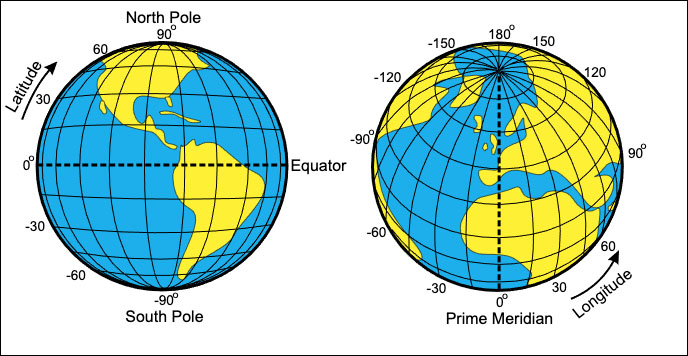
To find anyplace on the globe of Earth, you only need to know its latitude, the distance in degrees north or south of the equator, and longitude, the distance in degrees east or west of the prime meridian. The prime meridian is an imaginary line that runs through the Royal Observatory in Greenwich, United Kingdom, and extends to the North and South Poles. It defines the the zero (0°) longitude line just as the equator defines the 0° latitude line.
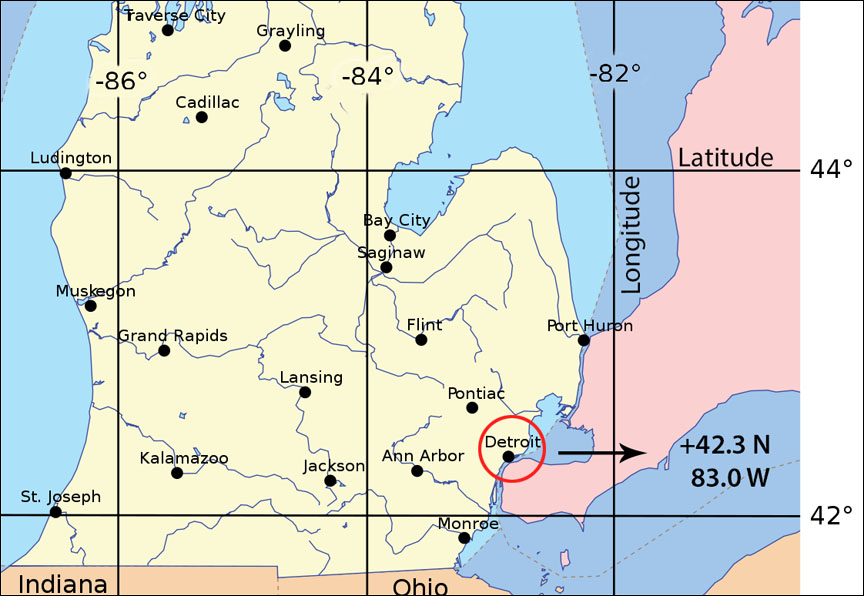
Each city has a unique latitude and longitude. Take Tuscaloosa, Alabama, for example, which is located at latitude +33.2° north, longitude 87.6° west. Or Wonglepong, Australia, situated along that continent's east coast at –27.0° south, 153.2° east. A negative sign in front of the latitude indicates south and a positive sign north. Every location, whether it be a city, airport, or even your own home or apartment building lies somewhere on the worldwide coordinate grid (below), its location fixed by two numbers.
CC0 1.0
Each degree of latitude is equal to about 111 kilometers on Earth's surface. For precision we break down degrees into either fractions of a degree or divisions calledminutes and seconds of arc. There are 60 minutes in one degree and 60 seconds in one minute. Tuscaloosa's precise location is +33° 12′ (minutes) 35″ (seconds) north, 87° 34′ 9″ west. You can convert fractions of degrees into minutes and seconds here.
CC 3.0 / Wikipedia

Right Ascension & Declination
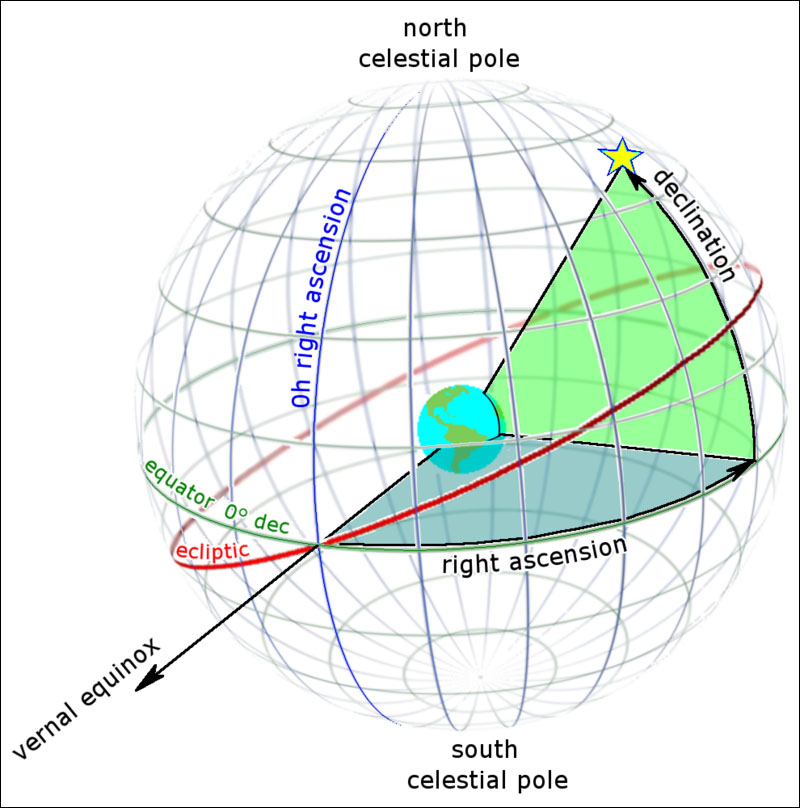
Like cities, every object in the sky has two numbers that fix its location called right ascension and declination, more generally referred to as the object's celestial coordinates. Declination corresponds to latitude and right ascension to longitude. There are no roads in the sky, so knowing an object's coordinates is crucial to finding it in your telescope.
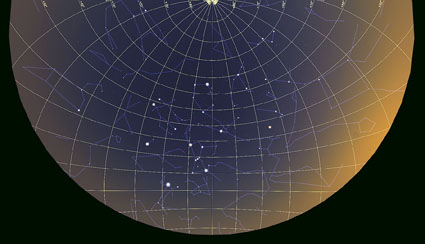
Let's use our imaginations and picture the latitude–longitude grid on the planet as the surface of a flexible, transparent soccer ball. If you could pump the ball up into a gigantic sphere centered on the Earth, you'd look up and see lines of latitude and longitude imprinted on the sky. The equator, which marks the 0° latitude line, now circles the sky as the celestial equator, while the north and south celestial poles hover over either end of the planet's polar axes.
Viewed from Earth's equator, the celestial equator begins at the eastern horizon, passes directly overhead and drops down to the western horizon. Since we're inside a sphere, it would continue around the backside of the Earth as well.
Tom Ruen / CC BY-SA 3.0
From mid-latitudes, the celestial equator stands midway between the horizon and overhead point, while from the poles the celestial equator encircles the horizon. Anything north of the celestial equator has a northerly declination, marked with a positive sign. Anything south of the equator has a negative declination written with a negative sign. For instance, Vega's declination is +38° 47′ 1″, while Alpha Centauri's is –60° 50′ 2″. One star is north of the celestial equator and the other south. Can you guess the declination of the north celestial pole? If you said +90°, you're already getting the hang of this.
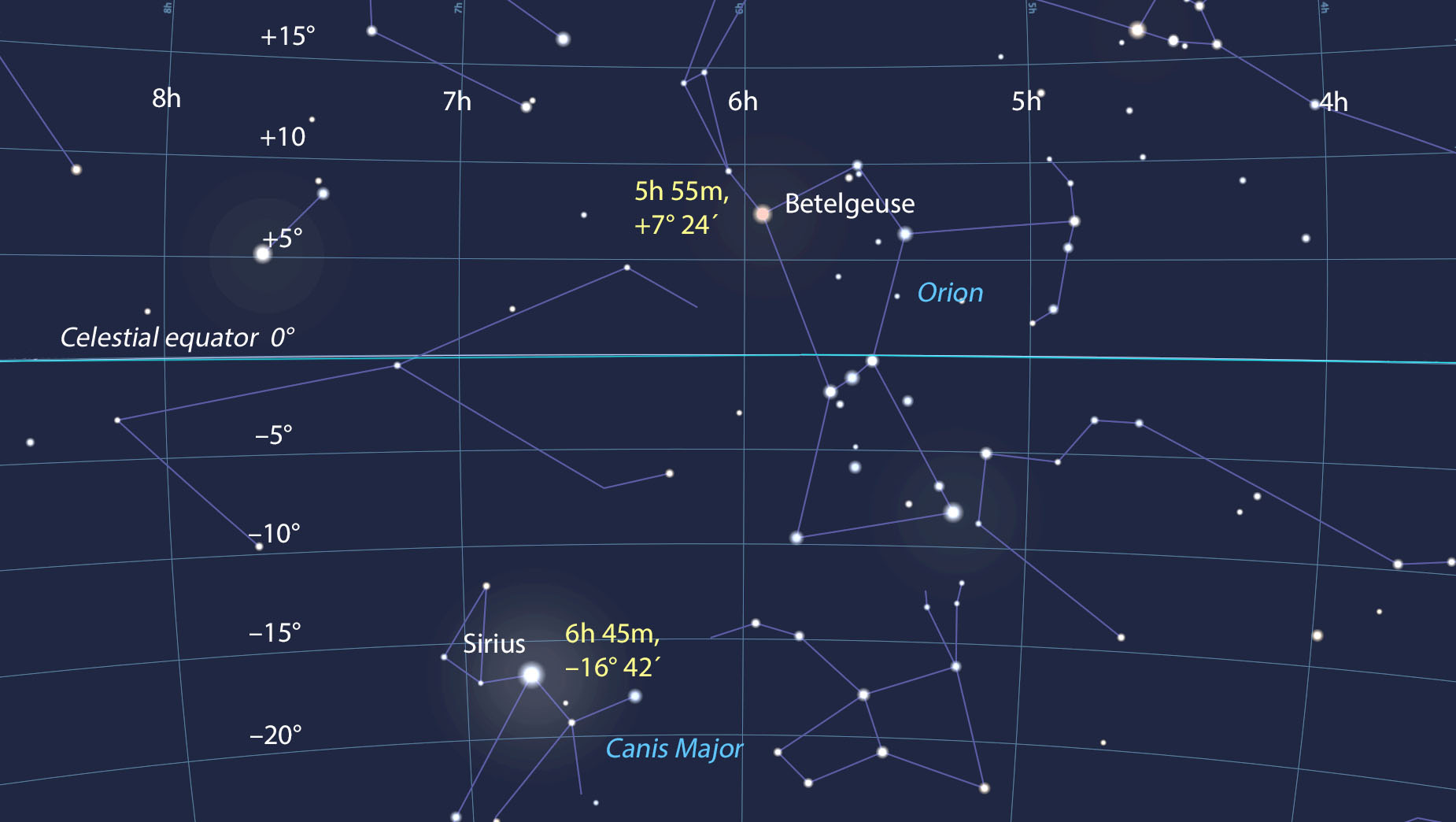
Stellarium
While we use a physical location on Earth as our reference for longitude, what reference do we use for right ascension? Where is the 0° mark in the sky separating east from west? Astronomers use the spot the Sun arrives at on the first day of spring, called the vernal equinox. Presently, it's located in the constellation of Pisces, the Fish. The sky can be treated as a clock, since it wheels by as Earth rotates, so the zero point of right ascension is called "0h" for "zero hours." Unlike longitude, right ascension is measured in just one direction — east. Because there are 24 hours in a day, each hour of right ascension measured along the equator equals 1/24th of a circle (360° divided by 24) or 15°. That's a little more than one-half the width of the W-shaped constellation Cassiopeia.
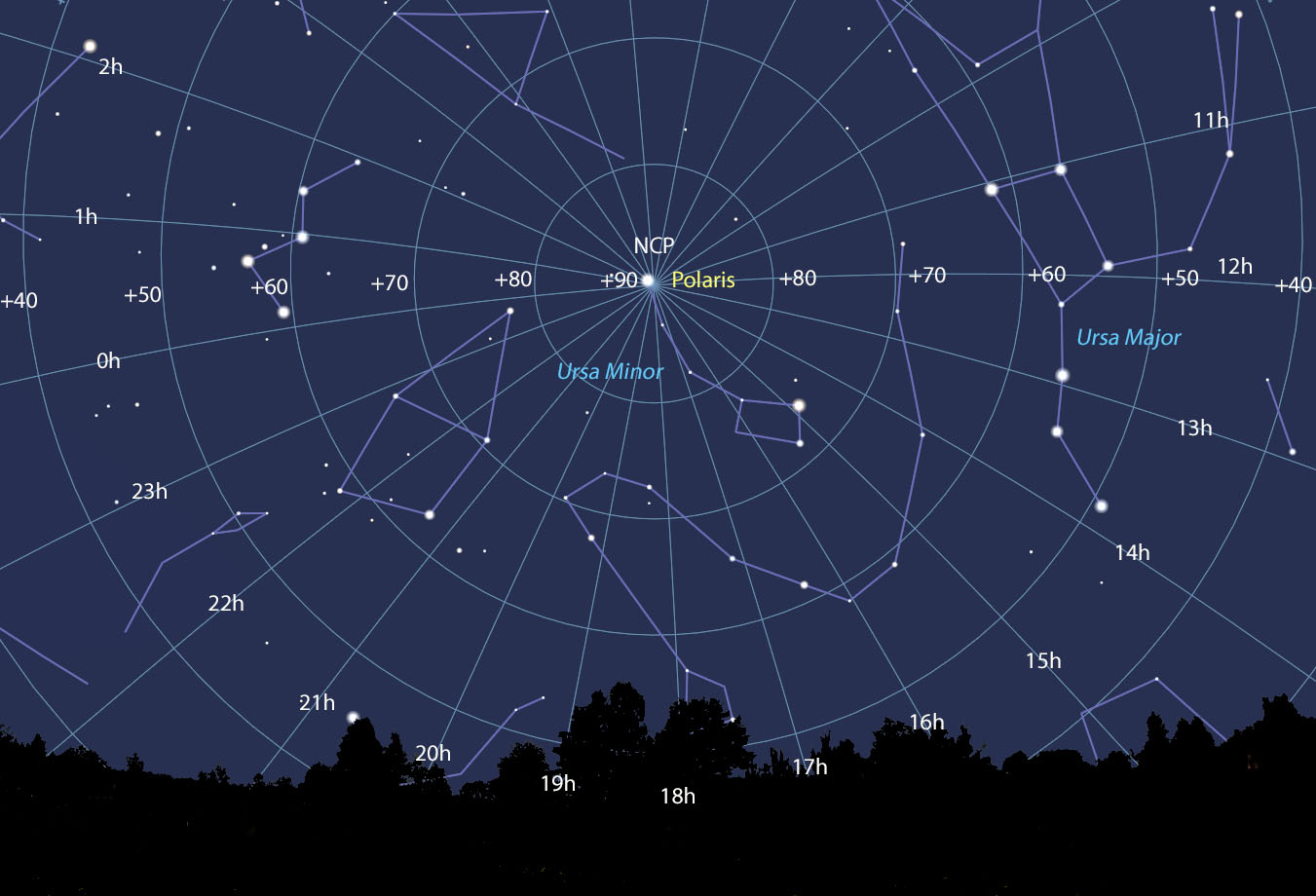
Stellarium
In keeping with right ascension's time theme, hours are subdivided into minutes and seconds, and are even written out as minutes (m) and seconds (s). Let take the North Star for example. Polaris is located at RA 2h 41m 39s, Dec. +89° 15′ 51″. Because the stars circle about the sky every 24 hours, right ascension or RA ranges from 0h to 24h. The star 29 Piscium, located immediately east of the equinox point is very close to 0h with an RA of 0h 01m 49s, while its neighbor, Omega (ω) Piscium, located justwest of the equinox point, has an RA of 23h 59m 19s.
Unlike Earth coordinates, celestial coordinates change due to the slow wobble of Earth's axis called precession. Precession causes the equinox points to drift westward at a rate of 50.3 arcseconds annually. As the equinox shifts, it drags the coordinate grid with it. That's why star catalogs and software programs have to be updated regularly to the latest "epoch." This is done every 50 years. Most catalogs and software currently use Epoch J2000.0 coordinates (for the year 2000). The next major update will happen in 2050.
Learning RA and Dec. provides you with a golden key to unlock the position of any object in the night sky. Before computer software effortlessly plotted the paths of newly discovered comets and fast-moving asteroids, I couldn't wait to get my hands on their coordinates. I'd hand-plot the positions on a paper star atlas, then swing my scope to the spot, and thrill when I found it on my own.
RA and Dec. also come in super-handy if you have a Go To telescope and a new comet or nova is discovered. Just input its coordinates, hit enter, and you're there. If you hear of a new comet or fast-moving asteroid, a quick check of its changing coordinates will tell you not only where it is but where it's headed, so you can plan the best time to see it.
I made friends with right ascension and declination long ago. Knowing I could drive anywhere on its invisible roadways helped me, and it'll help you too become more familiar with the night sky.
Where Does the North Celestial Pole Appear in Miami
Source: https://skyandtelescope.org/astronomy-resources/right-ascension-declination-celestial-coordinates/
0 Response to "Where Does the North Celestial Pole Appear in Miami"
Post a Comment