Two Ancient Civilizations Who Created Art andor Architecture Are the

5e. Fine art and Compages
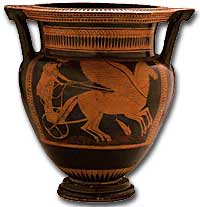
One popular form of Greek art was pottery. Vases, vessels, and kraters served both practical and artful purposes. This krater depicts Helios, the lord's day god, and dates from the 5th century B.C.East.
The arts reflect the society that creates them. Nowhere is this truer than in the instance of the aboriginal Greeks. Through their temples, sculpture, and pottery, the Greeks incorporated a fundamental principle of their culture: arete. To the Greeks, arete meant excellence and reaching ane'due south full potential.
Ancient Greek fine art emphasized the importance and accomplishments of human beings. Even though much of Greek fine art was meant to honour the gods, those very gods were created in the image of humans.
Much artwork was government sponsored and intended for public display. Therefore, art and architecture were a tremendous source of pride for citizens and could be found in various parts of the city. Typically, a city-state prepare aside a loftier-distance portion of land for an acropolis, an important role of the city-land that was reserved for temples or palaces. The Greeks held religious ceremonies and festivals as well as significant political meetings on the acropolis.
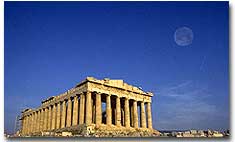
Photograph courtesy of www.sacredsites.com and Martin Gray
The Parthenon was built in accolade of the goddess Athena, who represented the human being aspiration for knowledge and the ideal of wisdom.

Greek Excellence: The Acropolis
In ancient Athens, Pericles ordered the construction of several major temples on the acropolis. Among these was a temple, the Parthenon, which many consider the finest instance of Greek architecture.
Built every bit a tribute to Athena, the goddess of wisdom for whom the city-state Athens was named, the Parthenon is a curiosity of design, featuring massive columns contrasting with subtle details.
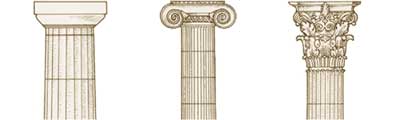
Three different types of columns tin exist found in ancient Greek architecture. Whether the Doric, Ionic, or Corinthian mode was used depended on the region and the purpose of the structure being built.
Many barely noticeable enhancements to the design of the Parthenon contribute to its overall beauty and balance. For example, each cavalcade is slightly wider in the middle than at its base and top. The columns are likewise spaced closer together well-nigh the corners of the temple and farther apart toward the center. In addition, the temple's steps curve somewhat — lower on the sides and highest in the center of each step.
Sadly, time has not treated the Parthenon well. In the 17th century, the Turks, who had conquered the Greeks, used the Parthenon to store armament. An accidental explosion left the Parthenon with no roof and in near ruin. In later years, tourists hauled away pieces of the Parthenon equally vacation souvenirs.
Beauty in the Human Form
Ancient Greek sculptures were typically made of either stone or woods and very few of them survive to this day. Most Greek sculpture was of the freestanding, man class (fifty-fifty if the statue was of a god) and many sculptures were nudes. The Greeks saw beauty in the naked human torso.
Early Greek statues called kouros were rigid and stood upward directly. Over time, Greek statuary adopted a more than natural, relaxed pose with hips thrust to one side, knees and arms slightly aptitude, and the head turned to one side.
Other sculptures depicted human action, peculiarly athletics. A good instance is Myron's Discus Thrower Another famous instance is a sculpture of Artemis the huntress.
The piece, called "Diana of Versailles," depicts the goddess of the hunt reaching for an arrow while a stag leaps adjacent to her.
Among the most famous Greek statues is the Venus de Milo, which was created in the 2d century B.C.E. The sculptor is unknown, though many art historians believe Praxiteles to take created the piece. This sculpture embodies the Greek ideal of beauty.
The aboriginal Greeks also painted, merely very little of their work remains. The most enduring paintings were those found decorating ceramic pottery. Two major styles include red figure (against a black background) and black figure (against a red background) pottery. The pictures on the pottery often depicted heroic and tragic stories of gods and humans.

If you like our content, please share it on social media!


Source: https://www.ushistory.org/civ/5e.asp
0 Response to "Two Ancient Civilizations Who Created Art andor Architecture Are the"
Post a Comment